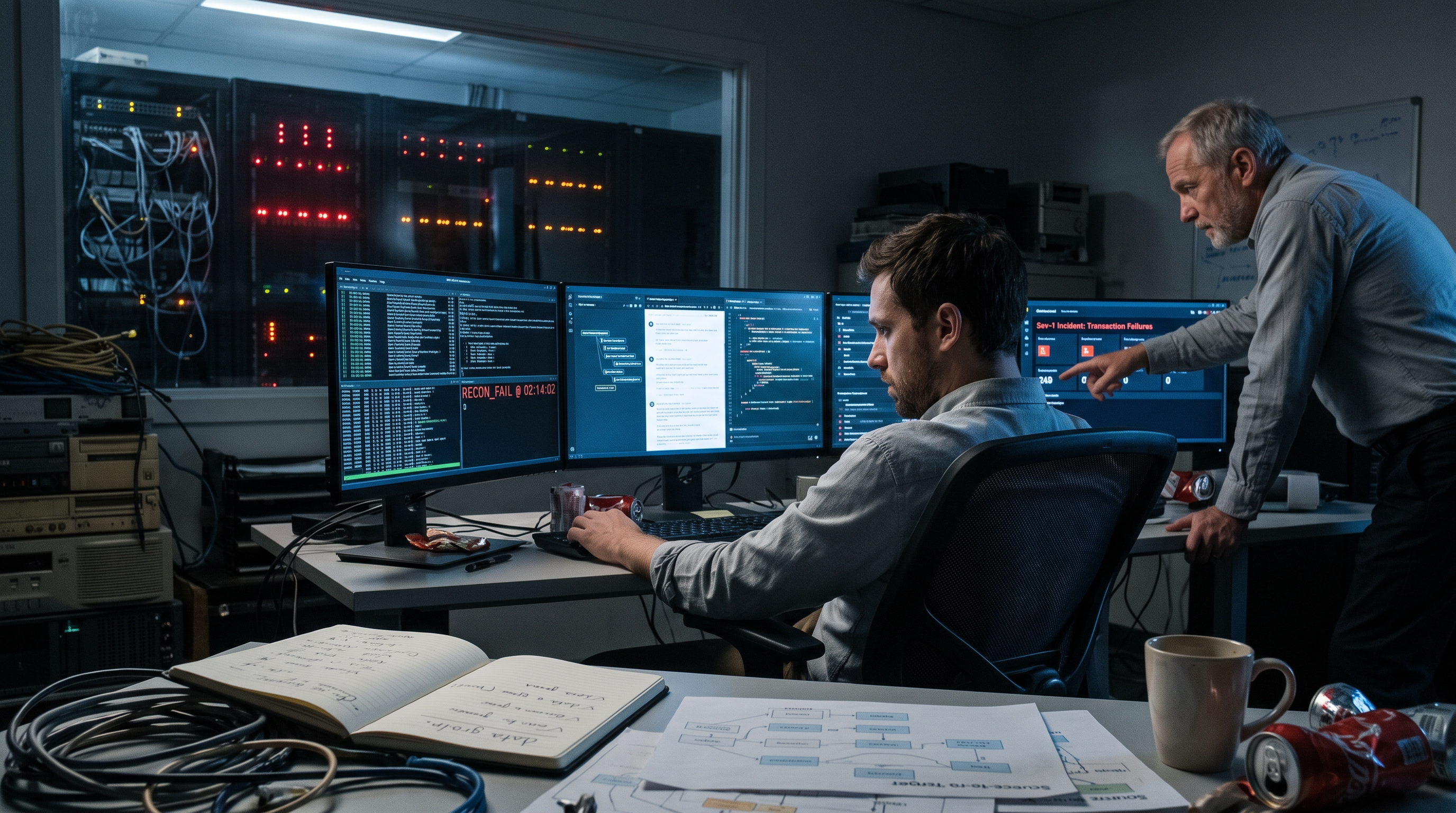
We Didn’t Eliminate Data Engineering Work. We Just Turned It Into Paranoid Auditing.
On paper, our data engineering velocity is up 400%. We’ve compressed three-week ETL pipeline builds into a couple of days using autonomous agents. In reality, the time we spend untangling silent data bugs has quietly doubled. We spent the last three years building the most sophisticated data agents
On paper, our data engineering velocity is up 400%. We’ve compressed three-week ETL pipeline builds into a couple of days using autonomous agents. In reality, the time we spend untangling silent data bugs has quietly doubled. We spent the last year building the most sophisticated data agents in history, only to discover we haven't eliminated the work—we just shifted it from writing code to an endless, exhausting cycle of paranoid auditing.
Walk the floor of my engineering organization today, and the bottleneck is no longer writing transformations. Our agents automatically generate source-to-target mappings, write their own PySpark unit tests, and spit out automated QA reconciliation reports in minutes. What used to take three weeks of heads-down development now wraps up in 48 hours.
Yet my senior data engineers are more burned out than they were in 2023. Why?
- We automated the mappings, but the time spent reviewing those mappings line-by-line has skyrocketed.
- The agents write the unit test scripts, but who verifies that the test mocks actually reflect production data shapes and business reality?
- The agents generate the QA reports, but engineers spend hours cross-checking raw staging tables to verify if the QA output itself is hallucinating a green light.
The initial coding phase collapsed, but the human time—the grueling client validation cycles, the back-and-forth over misunderstood grain and edge cases, and the silent schema bugs that slip past green CI pipelines right into executive dashboards—has exploded. My engineers are trapped in a paradox: the AI is too fast not to use, yet too unreliable to blindly trust.
Looking for a framework to explain this breakdown to our executive team, I didn’t find the answer in a 2026 AI benchmark. I found it in a five-page paper published in 1983 by a cognitive psychologist at University College London named Lisanne Bainbridge.
Her paper is called "Ironies of Automation," and though she was studying nuclear power plants and industrial chemical processes, she predicted our exact 2026 data engineering crisis down to the letter.
The Core Ironies of the "Self-Driving" Data Pipeline
In 1983, system designers operated on a simple premise: human operators are slow, variable, and error-prone, so automate them out of the loop wherever possible. Bainbridge pointed out that this mindset creates a set of compounding ironies:
| Bainbridge's Irony (1983) | Industrial Control Context | 2026 Agentic Data Engineering Reality |
|---|---|---|
| 1. The Leftover Principle | Designers automate what is predictable and easy to specify, leaving the human with an arbitrary collection of complex edge cases. | Agents instantly generate 90% of standard joins, staging views, and boilerplate scripts. Data engineers are left exclusively with messy grain mismatches, undocumented upstream quirks, and broken client logic. |
| 2. The Paradox of Supervision | The automated system is brought in because it computes faster across more variables than a human—yet the human is asked to monitor it for errors. | An agent generates a 600-line SQL transformation and a 400-line test suite in 30 seconds. A human engineer is expected to read the diff and spot a subtle LEFT JOIN fan-out that doesn't throw a syntax error. |
| 3. Loss of "Working Storage" | Operators only build an accurate mental map of the plant's state by actively steering it. Passive monitors step into emergencies "cold." | By skipping the manual struggle of profiling raw data and writing the mappings by hand, the engineer never builds a mental model of the data's edge cases—until the client flags wrong numbers in UAT. |
| 4. Designer Fallibility | Automation doesn't remove human error; it just moves it upstream into the system designer's assumptions. | Prompt templates, semantic layers, and agent rules still reflect incomplete specs. When the agent automates both the pipeline and the QA test from the same flawed prompt, it bakes the bug into the test itself. |
As Bainbridge summarized it over forty years ago: "The more advanced a control system is, so the more crucial may be the contribution of the human operator."
Why Writing Mappings by Hand Was Never Just "Typing"
For the last two years, the vendor pitch for AI in data engineering has treated writing SQL, Python, and mapping docs as pure mechanical friction—busywork standing between a business requirement and a dashboard.
Bainbridge’s research explains why eliminating that friction backfires. In her study of control rooms, she distinguishes between long-term knowledge (understanding how a database or plant works in theory) and working storage—the live, running mental context an operator builds only by actively interacting with the system.
In a data engineering project, manually building the source-to-target mapping was how our engineers built working storage.
When an engineer used to spend two weeks profiling filthy source tables, writing GROUP BY checks, discovering weird NULL patterns in legacy ERP columns, and wrestling with slowly changing dimensions, they weren't just producing code. They were paying the cognitive tax required to load the realities of the client's data into their own heads.
When an agentic workflow ingests a schema, infers the mappings, writes the transformations, and hands over a finished PR in two days, the engineer skips that struggle entirely. Then, when the client looks at the staging dashboard and asks, "Why is Q3 EMEA revenue off by 4.2%?"—the engineer is flying completely blind. They have to reverse-engineer both the client's raw data and the agent's synthetic logic from scratch under deadline pressure.
The "Quis Custodiet" Problem: Who Verifies the Verifier?
The classic engineering response to bad code is: "Write better tests and check the QA reports."
So we pointed our agents at testing. Now the agent generates the PySpark unit tests and builds the automated data-validation scripts. And suddenly, we hit Bainbridge’s Monitoring Paradox head-on.
First, when the same LLM context (or the same ambiguous Jira ticket) is used to generate both the transformation logic and the unit test, the test simply validates the hallucination. If the agent misunderstands how cancelled orders should be netted out of gross revenue, it will happily write a transformation that miscalculates net revenue, generate synthetic test fixtures that match its flawed formula, and show you a 100% passing test suite.
Second, human neurology is biologically incapable of catching these errors in review. Bainbridge cites Norman Mackworth’s famous 1950 vigilance studies, proving that human attention degrades rapidly within 30 minutes when monitoring mostly normal, plausible-looking streams of information.
More recently, researchers at Microsoft Research and the University of Edinburgh published "Ironies of Generative AI" (Simkute et al., 2025), documenting what happens when you turn knowledge workers from producers into evaluators. In data engineering, this is lethal:
- Unlike software engineering—where a bad line of code often throws an exception or breaks a UI button—bad data engineering fails silently. A slightly wrong window function or an unguarded join condition still compiles, runs green, and populates a table with plausible-looking floats.
- Reviewing a machine-generated unit test script or a 50-column mapping matrix is infinitely more exhausting than writing it. Because the agent gets 90% of the straightforward columns right, Automation Complacency kicks in—until one subtle grain explosion slips into a client review, destroys stakeholder trust, and triggers three weeks of frantic manual reconciliation.
We compressed three weeks of calm, methodical building into two days of generation—followed by two weeks of high-stress forensic auditing.
The 2030 Data Architect Crisis
There is a warning in Bainbridge’s 1983 paper that every Director and VP of Data needs to read closely:
"There is some concern that the present generation of automated systems, which are monitored by former manual operators, are riding on their skills, which later generations of operators cannot be expected to have."
Today, my Lead and Staff Data Engineers can still catch an agent’s subtle mistakes—when they have the energy to look closely—because they spent a decade getting burned by cartesian joins, timezone shifts, late-arriving dimensions, and floating-point rounding bugs. Their intuition was forged by manual failure.
What happens to the junior data engineers we hired in 2025 and 2026? If they spend their early careers prompting agents to generate mappings and rubber-stamping automated QA outputs, they never develop an intuitive feel for data shape and grain. You cannot learn data modeling strictly by reading diffs. If we eliminate the manual struggle for our juniors today, we will have no one capable of auditing the agents tomorrow.
Redesigning the Cockpit: How We Are Fixing Our Workflow
At the end of her paper, Bainbridge makes it clear that you cannot solve the ironies of automation by simply telling humans to "pay closer attention during reviews." Human cognition doesn't work that way. Instead, you have to redesign the workflow around human psychological limits.
Over the last six months, we overhauled how our data teams use agentic workflows to stop the cycle of paranoid auditing and slow back-and-forth client churn:
1. Ban the "Same-Brain" Test Trap (Orthogonal Verification) An agent that writes a transformation is never allowed to write the test or QA script that validates it. Furthermore, we stopped relying on LLM-generated unit tests with synthetic mock data. Instead, humans define the data contracts and business invariants (row-count conservation across joins, grain uniqueness, column sum reconciliation against immutable source ledgers), and deterministic engines enforce them against real production samples. The human writes the assertions; the agent writes the plumbing to satisfy them.
2. Mandatory Manual Data Profiling ("Warming the Cache") Before an engineer is allowed to trigger an agent to scaffold a pipeline or generate mappings, the engineer must manually profile the raw source datasets and write a brief Grain & Anomaly Memo. They have to get their hands dirty in the raw tables first—identifying primary keys, null distributions, and business edge cases by hand. This forces the engineer to build their "working storage" before the agent writes a single line of SQL.
3. Replace Full-Pipeline Generation with "Diff-in-Data" Slicing We stopped letting agents generate end-to-end, 15-table DAGs in one shot. Reviewing code diffs in SQL is a losing game because humans cannot mentally execute complex joins across five CTEs just by reading text. Instead, we enforce micro-slicing with data-level diffs: the agent builds one transformation layer at a time, and our tooling automatically surfaces distribution shifts, row-count deltas, and edge-case rows in the output data rather than asking the engineer to eyeball 500 lines of code.
4. Force the Agent to Expose Its Doubts Before Client Review To stop silent bugs from reaching client UAT, we changed our agent prompts from "Generate the mapping and QA report" to an adversarial interrogation pattern. Every agent-generated mapping must be accompanied by an Ambiguity Manifest: a strict list of every column where business logic was inferred rather than explicitly stated, every join where many-to-many fan-out is theoretically possible, and every filter condition that drops rows. Instead of hunting for needles in a haystack, the engineer starts their review directly at the fault lines.
The Real Cost of the 48-Hour Pipeline
Generating code was never the true bottleneck in data engineering. Shared understanding—between the raw data, the engineer's mental model, and the client's business reality—was always the bottleneck.
When you use autonomous agents to bypass the two weeks an engineer spends wrestling with the data, you don't get those two weeks back for free. You pay for them at the end of the project in endless QA verification loops, client escalations, and eroded trust.
Forty-three years ago, Lisanne Bainbridge proved that when you automate away the routine parts of a complex job without supporting the human's mental model, you turn skilled operators into exhausted, ineffective monitors. In 2026, winning in data engineering isn't about how fast your agents can spit out a mapping doc. It’s about building a system where your engineers actually understand—and can prove—what happens to the data after they hit Run.
Further Reading & References for Engineering Leaders
If you want to explore the deep research connecting classic control-room psychology to modern AI and data engineering workflows, here is the essential reading list:
- Bainbridge, L. (1983). "Ironies of Automation." Automatica, 19(6), 775–779.
- The foundational text. Explains why removing manual control degrades the exact cognitive "working storage" needed to diagnose anomalies and review system behavior.
- Simkute, A., Tankelevitch, L., Kewenig, V., Scott, A. E., Sellen, A., & Rintel, S. (2025). "Ironies of Generative AI: Understanding and Mitigating Productivity Loss in Human-AI Interaction." International Journal of Human-Computer Interaction, 41(5), 2898–2919 (Microsoft Research / University of Edinburgh).
- The modern bridge. Demonstrates empirically how shifting knowledge workers from active production to passive evaluation creates severe cognitive bottlenecks, reviewer fatigue, and hidden productivity loss.
- Mackworth, N. H. (1950). "Researches on the Measurement of Human Performance." Medical Research Council Special Report Series No. 268.
- The vigilance limit. The landmark study proving that human attention drops off a cliff within 30 minutes when auditing mostly working, monotonous outputs—explaining why manual reviews of massive AI-generated mapping sheets fail.
- Parasuraman, R., & Riley, V. (1997). "Humans and Automation: Use, Misuse, Disuse, Abuse." Human Factors, 39(2), 230–253.
- The trust paradox. Defines Automation Complacency (missing silent errors because the tool usually works) and Automation Disuse (rejecting the tool entirely and re-verifying everything by hand once trust is broken).
- Endsley, M. R. (2023). "Ironies of Artificial Intelligence." Ergonomics, 66(11), 1656–1668.
- The fluency trap. Explains how the high syntactic fluency of LLM outputs (clean SQL, well-formatted QA reports) actively masks semantic errors and reduces human situational awareness.
- Woods, D. D., & Dekker, S. (2000). "Anticipating the Effects of Technological Change: A New Era of Dynamics for Human Factors." Theoretical Issues in Ergonomics Science, 1(3), 272–282.
- The Substitution Myth. Proves why you cannot simply swap an automated agent into one phase of a workflow (like coding) without creating new, unanticipated cognitive burdens downstream (like verification and client UAT).
- Tankelevitch, L., Kewenig, V., Simkute, A., et al. (2024). "The Metacognitive Demands and Opportunities of Generative AI." Proceedings of the ACM CHI Conference on Human Factors in Computing Systems (CHI '24).
- The review burden. Breaks down why decomposing problems for agents and auditing their outputs requires intense metacognitive effort that exhausts senior engineers and overwhelms juniors.
Reactions
Discussion
No comments yet
Sign in as a member to join the discussion.
Keep reading
All stories
The Real AI ROI Playbook — How to Measure Engineering Productivity in the Age of AI
What factory electrification, the productivity paradox, and the theory of constraints reveal about measuring AI ROI in engineering—and how to build an operating model that delivers real economic value.

Your AI Coding Agents Are Faster. So Why Isn’t Engineering Getting Cheaper?
What factory electrification, the productivity paradox, and the theory of constraints reveal about measuring AI ROI in engineering.

How Databricks Turns a Messy Bucket of Parquet Files Into a Reliable Database
Data lakes used to be chaotic swamps where crashed pipelines left corrupted files and concurrent jobs silently overwrote each other. Discover how Delta Lake changes the game by using a single, hidden folder to bring ACID transactions, time travel, and absolute reliability to your cloud storage.