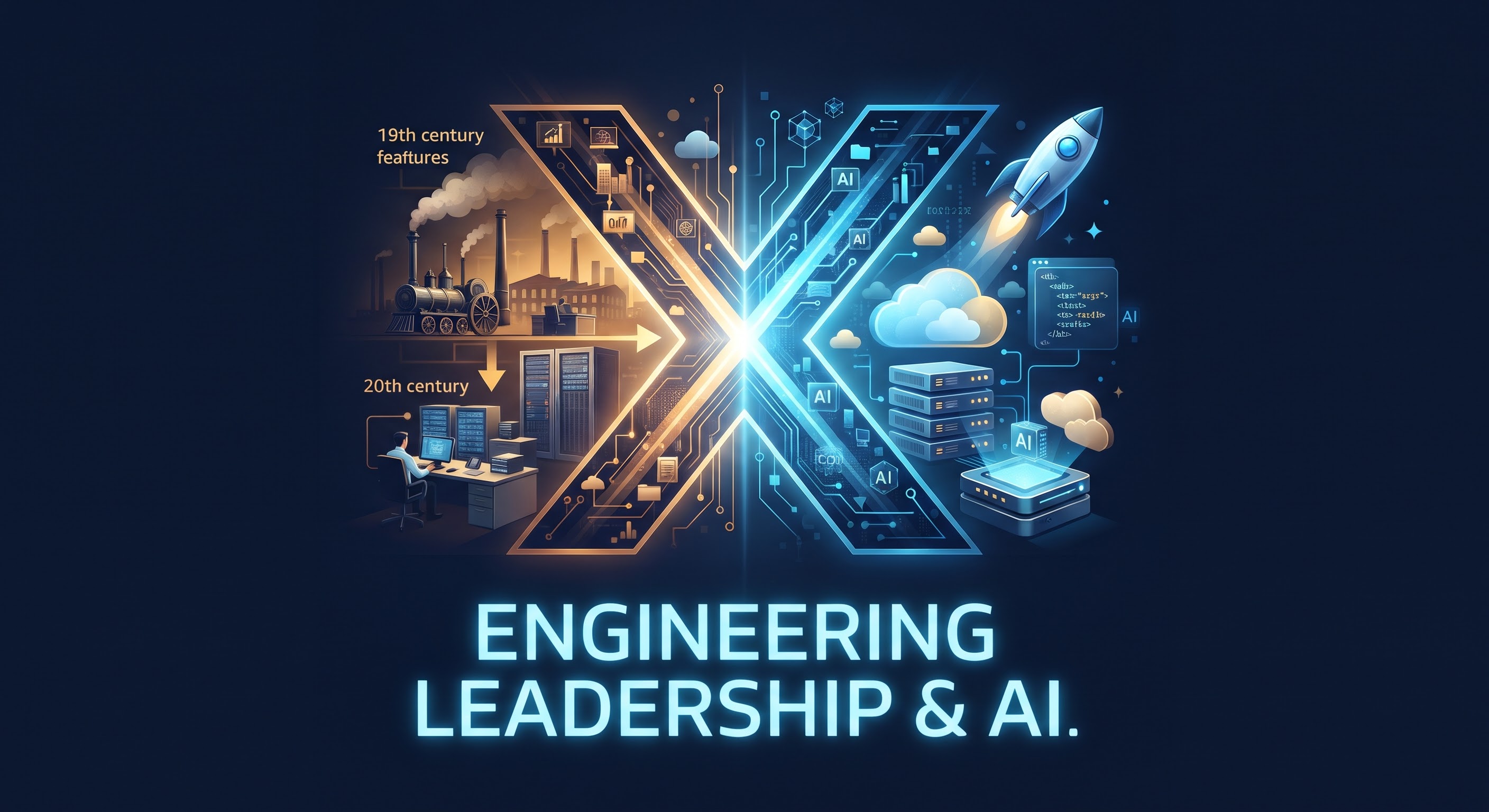
The Real AI ROI Playbook — How to Measure Engineering Productivity in the Age of AI
What factory electrification, the productivity paradox, and the theory of constraints reveal about measuring AI ROI in engineering—and how to build an operating model that delivers real economic value.
In Part 1, we explored why faster AI-assisted coding does not automatically make engineering cheaper. The historical lesson from factory electrification was straightforward: adopting a transformative technology is not the same as redesigning the system around it.
The same applies to AI-enabled engineering. If coding becomes faster, but testing, reviewing, validating, and deploying remain constrained by the old workflow, the organization may simply produce more work for the same delivery system to process.
So what should engineering leaders do about it?
The answer is not another AI adoption dashboard. It is not counting generated lines of code. And it is not asking every engineering manager to report an estimated productivity improvement at the end of the month.
We need an operating model that connects AI-assisted work to verified production outcomes, measures the cost of achieving those outcomes, and protects the quality and security of what we ship.
Here is how to build one.
1. Replace Coding Productivity with Verified Delivery Economics
Let's start with a metric that is simple enough for an executive dashboard but meaningful enough to influence engineering decisions. Call it Cost per Verified Production Delivery.
The idea is to measure the engineering effort and associated costs required to deliver a change that meets its acceptance criteria, passes the required quality and security controls, and reaches its intended production state.
Cost per Verified Delivery = Total Attributable Delivery Cost/Verified Production Deliveries
The denominator needs a careful definition. A pull request is not necessarily a delivery. A completed Jira ticket is not necessarily a delivery. A successful pipeline run is not necessarily proof of correctness.
For this metric, a delivery must satisfy a predefined outcome contract. Depending on the work, that contract might require:
- Acceptance criteria satisfied.
- Required tests passing.
- Security and policy checks passing.
- Data quality or API contract checks passing.
- Required approvals completed.
- Production deployment successful.
- Post-deployment validation completed.
For high-risk changes, the contract may also require a monitoring period or explicit operational sign-off. Not every change should have identical verification requirements—a documentation update and a change to a healthcare claims transformation should not be subjected to the same risk controls. The important point is consistency: define the conditions before measuring the outcome, not after the team has delivered it.
An Illustrative Example
Consider a team delivering comparable production changes in a month, assuming equivalent quality standards:
| Metric | Before AI | After AI | Net Operational Shift |
|---|---|---|---|
| Verified Deliveries | 100 | 120 | +20% volume |
| Total Attributable Engineering Effort | 1,000 hrs | 900 hrs | -10% effort |
| Effort per Verified Delivery | 10 hrs | 7.5 hrs | -25% effort per delivery |
In this example, verified delivery volume rises by 20%, while total engineering effort falls by 10%. Effort per verified delivery declines by 25%. That is a much more meaningful result than saying AI increased coding speed by 50%.
However, this is an effort-based calculation, not a complete financial ROI calculation. A true cost metric must include relevant labor costs, AI licensing, infrastructure, implementation costs, and other attributable expenses. The organization should also ensure that deliveries are comparable in scope and complexity. Otherwise, the metric can be manipulated accidentally—or deliberately (for example, by splitting one feature into ten tiny tickets).
To prevent this, classify work into comparable categories, establish clear delivery boundaries, and report quality alongside cost. The objective is not to make the number look good. It is to make the number useful.
2. Measure the Entire Delivery System, Not Just Implementation
Cost per verified delivery tells us what happened. It doesn't tell us why. To understand the cause, we need to examine the workflow. A useful delivery model separates active work from waiting time.
The AI-Era Engineering Workflow
(Illustrative workflow stages. Your actual constraints should be established from observed delivery data.)
- Requirements & Design: Clarification and scope. Define expected behavior, dependencies, edge cases, and acceptance criteria.
- Implementation : AI acceleration. Generate, modify, and review code locally; run fast feedback checks.
- Verification : Potential constraint. Validate behavior, tests, security, data quality, and business rules.
- Release: Approval and promotion. Apply release policies, deploy through controlled environments, and validate the result.
- Production Outcome: Confirm the change is working and meets its intended acceptance contract.
For each stage, measure three things:
- Active effort: How much human or machine work is required?
- Queue time: How long does work wait before something processes it?
- Rework: How much effort is spent correcting or repeating previous work?
This distinction matters because an engineering process can have very little coding time and still take days to deliver a change. Imagine that AI reduces implementation from six hours to two. But the pull request waits 18 hours for review, spends another eight hours awaiting test fixes, and waits another day for a release window.
The developer's coding time has improved dramatically. The elapsed delivery time has not improved proportionally. If your organization measures only implementation time, you will miss the constraint. If it measures the full delivery path, you can see where AI has helped, where it has created additional demand, and where the next investment should go.
3. Track Five Metrics That Connect AI to Engineering Outcomes
Engineering leaders don't need 40 new AI metrics. They need a small set that answers different questions. Begin with five:
- Metric 1: Cost or Effort per Verified Delivery (Efficiency) — Are we delivering comparable outcomes more efficiently? Track fully attributable delivery cost where reliable financial data is available. Until then, use engineering effort per verified delivery as a leading operational measure.
- Metric 2: Mean Time to Verify (Flow) — How long does it take to establish that a change is safe and correct? Measure from the point implementation is ready for verification to the point all required verification checks are complete. Track median and upper-percentile values.
- Metric 3: Rework Ratio (Friction) — How much work must be repeated or corrected? Track effort spent correcting defects, failed assumptions, rejected implementations, and changes that must be redone.
- Metric 4: Escaped-Defect Cost and Severity (Guardrail) — Are faster deliveries preserving production quality? Monitor defects discovered after release, severity, time to recovery, customer impact, and remediation effort.
- Metric 5: Realized Capacity and Business Contribution (Economic Conversion) — What did the organization gain from the time saved? Track whether released capacity becomes more verified deliveries, shorter lead times, reduced contractor spending, or avoided planned hiring.
Why these metrics work as a system:
If effort per delivery declines while verification time and escaped defects rise, the organization may be optimizing implementation at the expense of quality.
If verification time falls but delivery volume remains flat, requirements, approvals, dependencies, or release windows may be the next constraint.
If delivery efficiency improves but no additional value is realized, the organization may have created capacity without a plan to use it.
4. Make Verification a First-Class Engineering Capability
This is the most important operational change. If AI increases the rate at which code is produced, verification cannot remain an informal activity dependent on whichever senior engineer has time to review the work. It needs explicit ownership, clear standards, automated checks, and risk-based controls.
Layer 1: Define the Contract Before Implementation
Every meaningful change should have a clear description of what must be true when it is complete. For a data pipeline, this could include source/target schemas, business rules, uniqueness/nullability expectations, reconciliation tolerances, lineage, permitted access behavior, and downstream compatibility.
- The Rule: AI can help interpret requirements, identify missing information, and draft test cases. But an accountable engineer must resolve ambiguous business decisions. A model should never silently invent the missing meaning of a healthcare field in production.
Layer 2: Automate Deterministic Checks
Use conventional software controls wherever expected behavior can be expressed deterministically: formatting, linting, static analysis, unit/integration tests, type/schema validation, dependency/vulnerability scanning, secret detection, data quality assertions, API contracts, and CI/CD policy enforcement.
- The Rule: These checks run automatically and consistently regardless of whether code was written by a developer or generated by an AI agent. Implementation method never determines the verification standard.
Layer 3: Apply Human Review Where Judgment Matters
Automated tests cannot prove every property of a system. Human review remains critical for architectural trade-offs, business semantics, security implications, maintainability, and incomplete acceptance criteria.
- The Rule: Direct human attention to decisions automated controls cannot settle, supported by small PRs, clear change summaries, and automated test evidence.
Layer 4: Promote Through Controlled Release Gates
Passing tests should not automatically grant unrestricted production access. Production promotion follows explicit policies appropriate to system risk: environment approvals, separation of duties, signed artifacts, identity/access controls, audit logs, rollback plans, and post-deployment checks.
5. What This Looks Like in Data Engineering
The verification problem becomes especially visible in data engineering because a pipeline can execute successfully while producing incorrect results across a Medallion architecture:
- Bronze: Source ingestion and raw data preservation.
- Silver: Standardization, cleansing, mappings, and business rules.
- Gold and Downstream: Analytics, measures, extracts, and data sharing.
⚠️ The Silent Failure Mode: Suppose an AI agent generates a transformation that joins claims to member records. The code compiles. The job completes. The target Delta table is created. But the join uses a non-unique member key, duplicating some claims. The pipeline is operationally successful and semantically wrong.
A well-designed verification system asks: Did the transformation preserve the expected grain? Did records reconcile within tolerances? Did the join create unexpected duplication? Are downstream consumers compatible?
Separating Proposal from Execution
- AI-Assisted Development: The model helps an engineer write or modify a transformation; existing controls remain in force.
- Agent-Driven Implementation: An agent interprets requirements, proposes mappings, generates code/tests, and prepares changes.
- Proposals: Agents suggest mappings and explain failures.
- Execution: Deterministic pipelines enforce schemas, quality contracts, and permissions; authorized engineers resolve ambiguity and approve risk-sensitive gates.
6. Should Production Deployment Be Owned by a Separate Team?
The better question is not whether one team or two teams own deployment—it is which decisions require independent authorization, and which steps can be safely automated?
| Responsibility | Suggested Owner |
|---|---|
| Develop pipeline logic and tests | Feature or data engineering team |
| Define business acceptance criteria | Product, BA, data owner, and engineering |
| Maintain shared CI/CD tooling & release policies | Platform engineering / SRE / release engineering |
| Execute automated promotion after gates pass | Controlled deployment system (Automated) |
| Approve high-risk / exceptional production changes | Authorized independent approver |
| Monitor production and respond to incidents | Shared operational ownership with clear on-call accountability |
For mature platforms, routine promotions handle automatically when conditions are met; independent approval is reserved for changes requiring it.
7. Turn Time Saved into Measurable Business Value
Suppose AI reduces implementation effort by 30%. What does the organization actually gain? There are six distinct outcomes—and they must not be counted twice:
- Outcome A (More Delivery Capacity): Delivering more verified changes without increasing working hours.
- Outcome B (Faster Time to Market): Customers receive important capabilities sooner, creating earlier revenue or reducing delays.
- Outcome C (Lower Expenditure): Reducing contractor spending, overtime, or avoidable costs.
- Outcome D (Avoided Future Cost): Meeting demand growth without hiring as many additional engineers as planned.
- Outcome E (Better Quality): Reducing defect remediation, incidents, or customer-impacting failures.
- Outcome F (Engineering Sustainability): Reducing repetitive toil and pressure while maintaining a predictable pace.
8. Conclusion: Measure What Reaches Production, Not What Leaves the Model
Over time, the most effective engineering organizations will move toward a model in which AI agents handle an increasing share of implementation and routine diagnostic work, while deterministic systems and accountable humans govern the conditions under which changes are accepted and released.
That is why you should start with one question:
“How much does it cost us to deliver a verified, valuable production outcome—and how is AI changing that number without compromising quality?”
The next competitive advantage will not belong automatically to the company with the most AI tools or the largest fleet of coding agents. It will belong to the company that learns how to integrate those capabilities into a system that consistently delivers better outcomes.
AI makes implementation cheaper. Engineering leadership determines whether that becomes business value.
References and Further Reading
- Brynjolfsson, E., Rock, D., & Syverson, C. (2021). The Productivity J-Curve: How Intangibles Complement General Purpose Technologies. American Economic Journal: Macroeconomics.
- Goldratt, E. M. (1984). The Goal: A Process of Ongoing Improvement.
- Forsgren, N., Humble, J., & Kim, G. (2018). Accelerate: The Science of Lean Software and DevOps. IT Revolution.
- Dell'Acqua, F., et al. (2023). Navigating the Jagged Technological Frontier. Harvard Business School working paper.
- David, P. A. (1990). The Dynamo and the Computer: An Historical Perspective on the Modern Productivity Paradox. The American Economic Review.
Reactions
Discussion
No comments yet
Sign in as a member to join the discussion.
Keep reading
All stories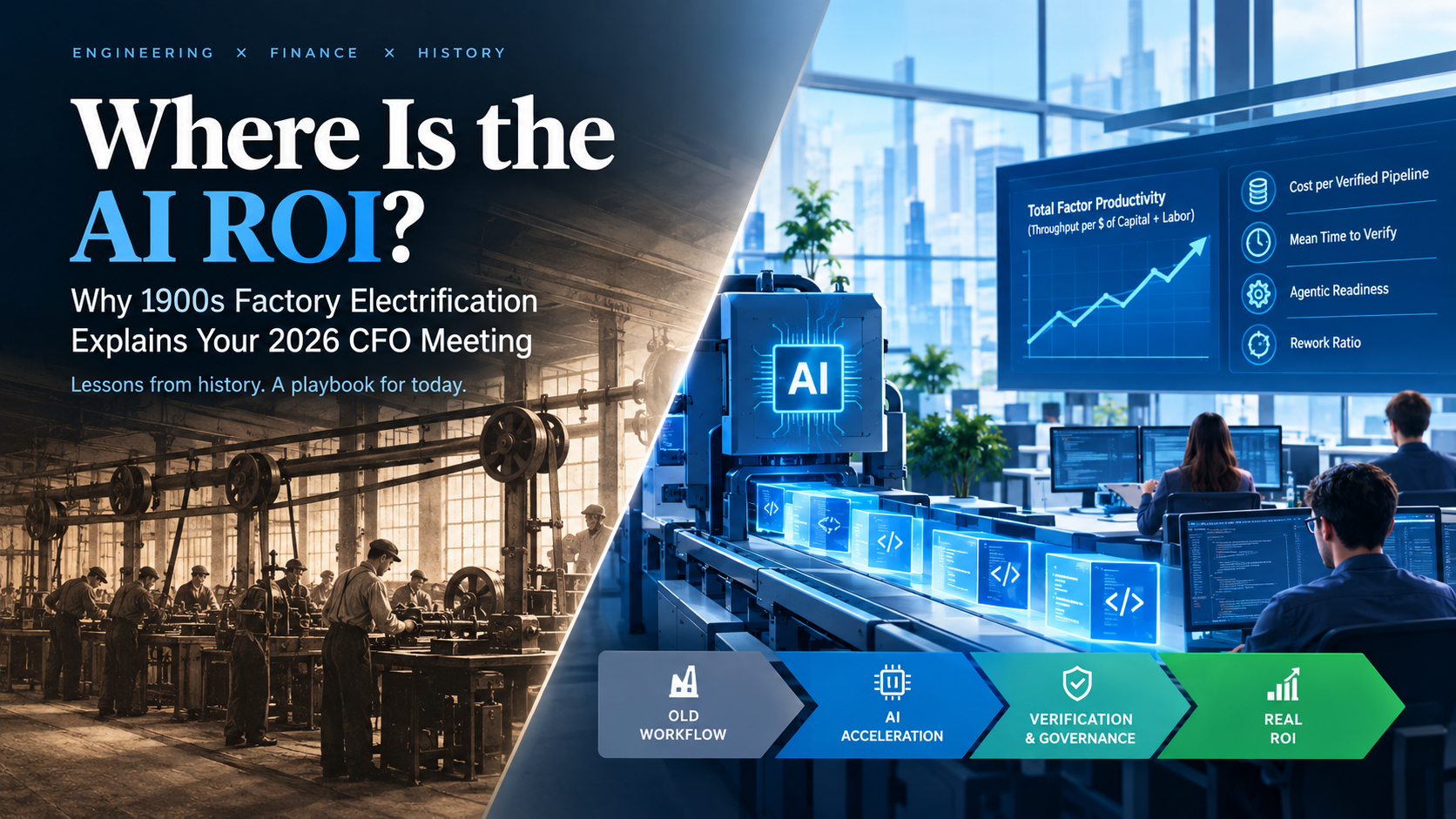
Your AI Coding Agents Are Faster. So Why Isn’t Engineering Getting Cheaper?
What factory electrification, the productivity paradox, and the theory of constraints reveal about measuring AI ROI in engineering.

We Didn’t Eliminate Data Engineering Work. We Just Turned It Into Paranoid Auditing.
On paper, our data engineering velocity is up 400%. We’ve compressed three-week ETL pipeline builds into a couple of days using autonomous agents. In reality, the time we spend untangling silent data bugs has quietly doubled. We spent the last three years building the most sophisticated data agents

How Databricks Turns a Messy Bucket of Parquet Files Into a Reliable Database
Data lakes used to be chaotic swamps where crashed pipelines left corrupted files and concurrent jobs silently overwrote each other. Discover how Delta Lake changes the game by using a single, hidden folder to bring ACID transactions, time travel, and absolute reliability to your cloud storage.